
Home- Blogs- Bearing Knowledge-How to Choose Crossed Roller Bearings for CNC Rotary Tables
Selecting a crossed roller bearing for a CNC rotary table is rarely a simple catalogue lookup. The bearing sits at the intersection of positioning accuracy, structural rigidity, and long-term reliability, so a wrong choice shows up months later as chatter marks, thermal drift, or a table that no longer holds tolerance. Engineers searching for guidance on this topic usually have a specific machine design in front of them and need to justify a decision to a project manager, a customer, or themselves. This article walks through the technical criteria that actually determine performance, the trade-offs between common bearing configurations, and the supplier checks that separate a reliable precision bearing from an expensive spare part.
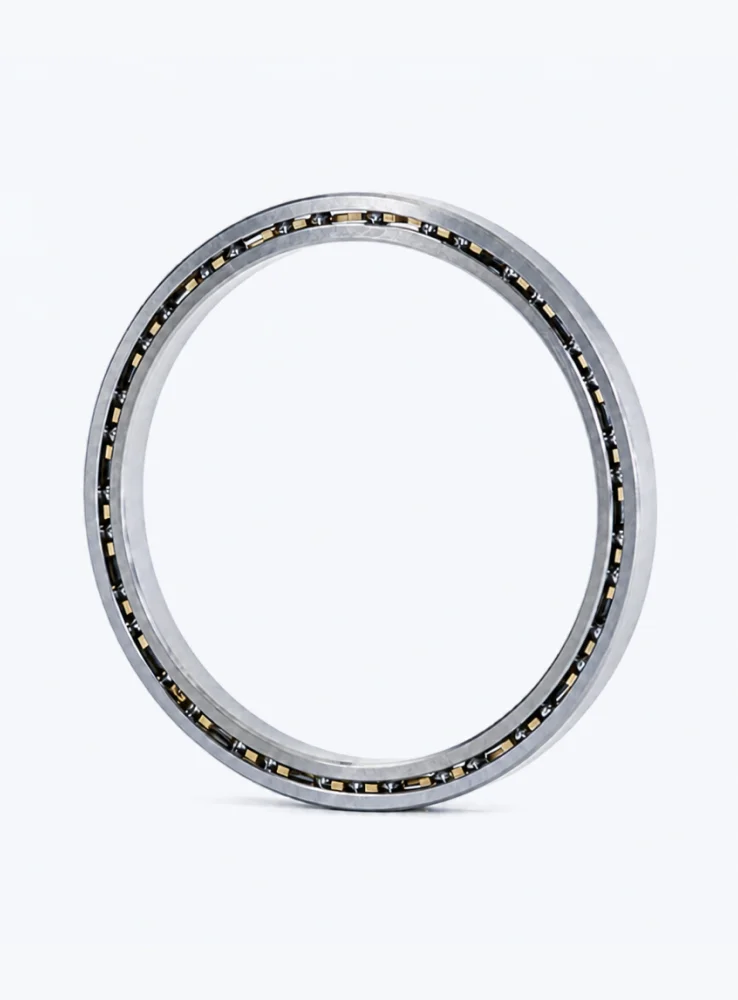
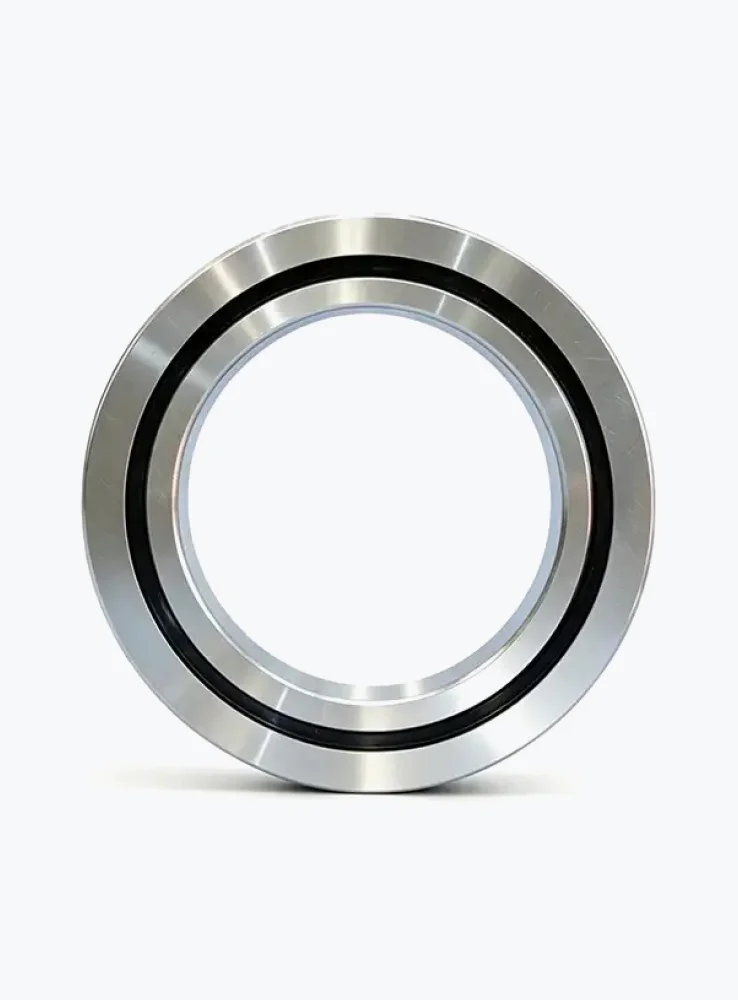
A crossed roller bearing uses cylindrical rollers arranged at 90 degrees to one another in a single raceway, alternating in orientation. That arrangement lets one compact bearing absorb radial load, axial load, and tilting moment simultaneously. In a rotary table, this single-bearing capability is the main appeal: it replaces a multi-bearing stack, shortens the axial height of the assembly, and removes the tolerance stack-up that comes with pairing a thrust bearing and a radial bearing.
Rigidity matters more than raw load rating in most machining applications. A table that deflects under cutting force will produce dimensional error even if the servo loop is perfectly tuned. Crossed roller bearings offer high stiffness because the rollers contact the raceway over a line rather than a point, and because preload removes internal clearance. The practical consequences are reduced tool deflection, better surface finish, and higher achievable feed rates.
In an indexing table, the bearing defines the axis of rotation. Any runout in the inner or outer ring is translated directly into angular positioning error at the workpiece. This is why precision grades and matched ring pairs are specified for rotary axes rather than for general machinery.
Start by calculating the combined load case: workpiece weight, fixture weight, cutting forces in three axes, and the moment arm created by an off-centre workpiece. Moment load is frequently underestimated. A heavy part mounted at the edge of a table creates a tilting moment that can exceed the axial load by a large factor. The bearing must be rated for the resulting equivalent load, not just the vertical weight.
Precision classes such as P5, P4, and P2 describe permissible radial and axial runout. Higher grades cost more and take longer to deliver. For a grinding or measuring application, P4 or better is normally justified. For a general-purpose positioning table, P5 may be entirely adequate. Over-specifying accuracy is one of the most common ways to inflate machine cost without improving output.
Preload eliminates clearance and increases stiffness, but it also increases friction torque and heat generation. In a worm-gear table, excessive preload can distort the gear mesh and accelerate wear. In a direct-drive table, friction torque directly affects motor sizing and current draw. The right preload is a balance point determined by required stiffness and available drive torque, not simply the highest value available.
Rotary tables that index rapidly or contour at high speed generate heat in the bearing. Lubrication type and replenishment intervals must match the duty cycle. Grease-for-life designs suit slow indexing tables; oil or circulating lubrication suits continuous high-speed motion. Thermal expansion of the bearing and housing also influences final accuracy, so the design should account for operating temperature rather than only the assembly bench condition.
Bore diameter, outer diameter, and axial height define what will physically fit. Crossed roller bearings are available in several standard series, and the choice between them often comes down to whether the housing can accommodate a flanged outer ring, an integrated gear, or a split inner ring for simplified assembly.
The following comparison reflects how different bearing solutions typically behave in rotary table applications:
For most CNC rotary tables in the small to medium size range, crossed roller bearings offer the best balance of stiffness, height, and cost. When the table must resist very large overturning moments, a YRT-style arrangement becomes the more rational choice.
A horizontal axis carrying a heavy chuck places a constant moment on the bearing and often benefits from a wider roller complement. A vertical axis with a centred load is dominated by axial and radial forces, so a narrower section may be sufficient.
Worm-driven tables tolerate somewhat higher friction torque and are generally less sensitive to preload variation. Direct-drive tables demand low and consistent friction torque, because the motor must control position without a mechanical reduction stage to mask irregularities.
Two bearings with identical catalogue numbers can perform very differently depending on manufacturing discipline. When qualifying a source, request and verify the following:
BIBO Bearing supplies precision crossed roller bearings for machine tool and rotary table applications, with measured inspection data provided alongside delivery so that the specified accuracy grade can be confirmed before the bearing is pressed into the housing.
In many designs, yes. Because it carries radial, axial, and moment loads simultaneously, a single crossed roller bearing can support the table and define its axis of rotation, provided the load case has been calculated correctly.
No. Preload raises stiffness but also raises friction torque and heat. Beyond a certain point, thermal growth reduces accuracy rather than improving it. Preload should be matched to the required stiffness and the available drive torque.
Significantly. A precision bearing mounted on an out-of-flat or poorly machined seat will conform to that error, resulting in runout that the bearing grade alone cannot prevent. Housing and shaft surfaces should be finished to the tolerances specified for the bearing class.
Choosing crossed roller bearings for a CNC rotary table comes down to four decisions: defining the real load case including moment load, selecting the accuracy grade the application genuinely requires, setting preload against drive capability, and qualifying a supplier who can prove measured performance. Get those four right, and the bearing becomes an invisible contributor to machine accuracy. Get them wrong, and no amount of servo tuning will compensate.