
Home- Blogs- Bearing Knowledge-Miniature Crossed Roller Bearings: 5 Surprising Applications
Miniature crossed roller bearings are often overlooked as simple machine elements, yet their unique design—cylindrical rollers arranged perpendicularly in a compact raceway—delivers exceptional rigidity and rotational accuracy in the smallest envelopes. While most engineers associate them with robotic joints, these components quietly power a far wider range of high-precision systems. From semiconductor fabs to orbital satellites, miniature crossed roller bearings solve motion-control challenges that conventional ball bearings simply cannot. This article explores five surprising applications where this specialized bearing type makes the critical difference, and explains why BIBO Bearing’s manufacturing expertise matters in each scenario.
In semiconductor fabrication, wafers must travel through hundreds of process steps without ever touching a surface by hand. The robots that move these fragile disks rely on precision bearings in every rotating axis. While large crossed roller bearings support the main arm, miniature versions are used in the wrist axes, end-effector alignment stages, and sensor gimbals that guide the wafer into position.
The reason is rigidity under combined loads. A wafer robot accelerates and decelerates rapidly, generating tilting moments that would deform a ball bearing’s point contacts. Crossed roller bearings use line contact, which spreads the load over a much larger area. This yields five to ten times greater static stiffness in the same envelope size. For a robot that must land a 300 mm wafer on quartz pins with under 50 microns of error, bearing deflection is simply unacceptable.
Miniature crossed roller bearings from BIBO Bearing can be supplied with porous cage materials or fully sealed grease options that comply with vacuum outgassing limits. The separable rings also simplify cleaning and re-lubrication in controlled environments. Without these properties, a bearing would become a contamination source—a fatal flaw in a cleanroom.
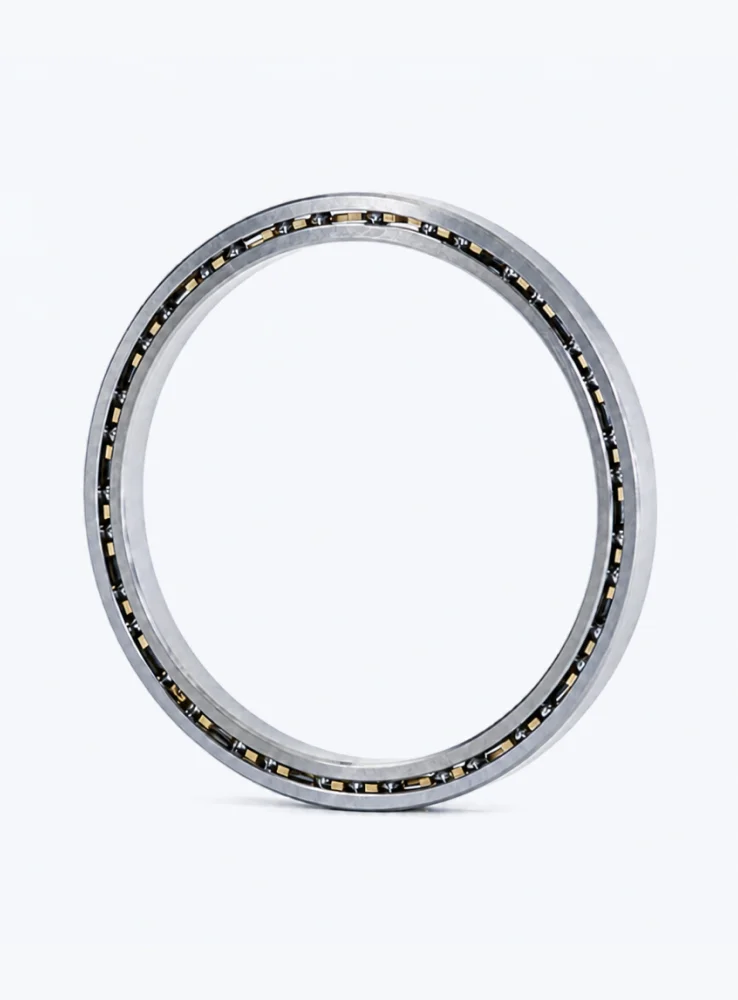
Medical imaging equipment such as CT scanners and C-arm X-ray systems must rotate a heavy emitter-and-detector assembly around a patient with sub-arcsecond consistency. The main gantry bearing is typically a large crossed roller bearing, but miniature versions appear inside the collimator, the detector positioning mechanism, and the calibration wheel.
These tiny bearings enable the fine angular adjustments that keep the radiation beam aligned with the detector array. If the bearing has excessive play, the resulting image blur can force a patient to be re-scanned—increasing radiation exposure and operational cost. With axial runout below 2 micrometers, miniature crossed roller bearings maintain the geometric integrity of the imaging chain over millions of cycles.
Hospitals require equipment that runs 24/7. Crossed roller bearings distribute stress evenly, so fretting wear is drastically reduced compared to ball types. BIBO Bearing’s ground rollers and hardened raceways deliver a rated service life exceeding 10,000 hours under typical imager loads, with noise levels below 30 dB during operation.
Laser trackers, interferometers, and telescope mounts demand rotation that does not introduce angular errors into the optical path. A mirror rotating on a skewed axis can produce a pointing error many times larger than the bearing’s own runout. Miniature crossed roller bearings are specified in these instruments because they offer both high moment rigidity and a small cross-section.
One surprising use is inside rapid-scanning galvo mirrors for laser engraving and lidar optics. Here, a mirror oscillates at hundreds of hertz while maintaining a perfectly flat plane of rotation. The bearing must withstand continuous alternating torque without raceway brinelling. Traditional ball bearings fail due to localized stress at each ball contact; crossed rollers spread the load and survive billions of cycles.
Optical systems also face temperature changes that alter component dimensions. Crossed roller bearings can be designed with matched thermal expansion coefficients by selecting ring materials such as stainless steel or bearing steel with the same CTE as the housing. BIBO Bearing offers custom preloads that remain stable between 10 °C and 40 °C, preserving focus and stable laser alignment.
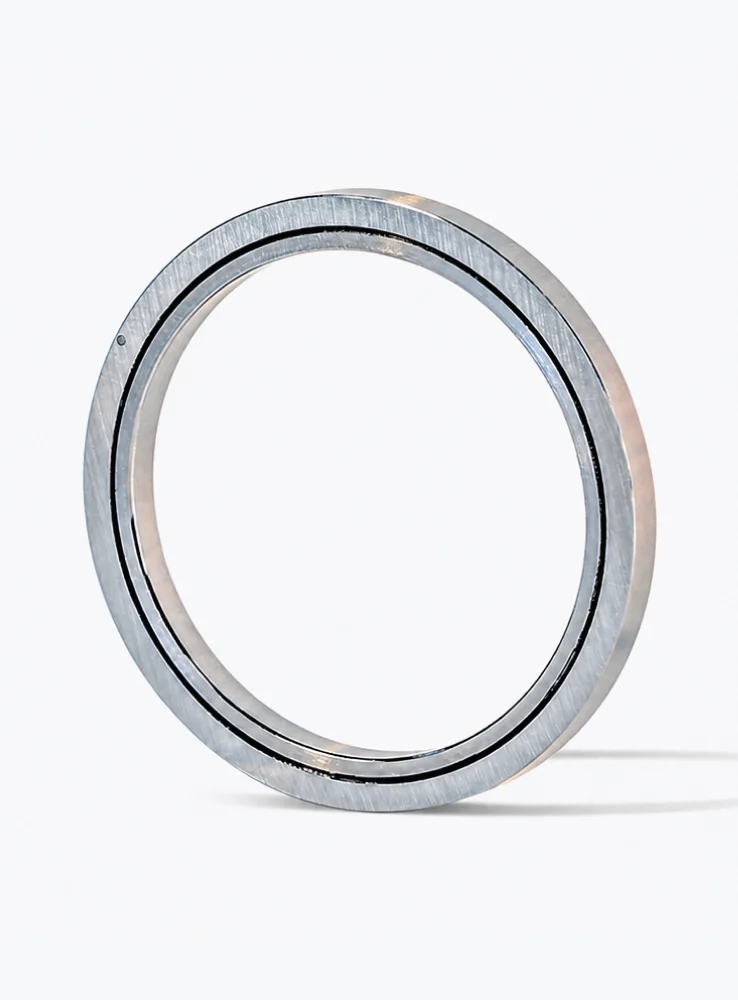
In orbit, a satellite’s solar array must track the sun with an accuracy of a few tenths of a degree. The rotary actuator that performs this is commonly built around a crossed roller bearing because of its space-saving thin section and ability to handle the overturning forces caused by thermal gradients and solar pressure.
Miniature versions are used in smaller satellites, CubeSats, and deployable antenna hinges. These bearings must operate in extreme vacuum, with temperature swings from −70 °C to +120 °C, and often without any additional lubrication for years. The unique line-contact geometry of crossed rollers prevents the cold-welding and micro-fretting that can seize a ball bearing in space.
Every gram matters in spacecraft design. A miniature crossed roller bearing can use a thin-section ring that reduces mass by up to 40% compared to a conventional deep-groove ball bearing with equivalent moment capacity. BIBO Bearing has supplied coated variants—including TiN and MoS₂—for missions where dry lubrication is mandatory.
Mechanical LiDAR sensors rely on a rotating mirror or a spinning laser array to scan a 360-degree field around a vehicle. The rotation unit spins at up to 1,200 RPM and must maintain a steady axis while experiencing shocks from road vibration. Miniature crossed roller bearings provide the required stiffness and low friction.
The challenge is especially severe at the upper bearing position, where the scanning head overhangs. A small axial play translates directly into vertical wobble of the laser beam, degrading point cloud accuracy at longer ranges. Crossed roller bearings handle the moment load with negligible axial play under preload, ensuring the emitted light stays on target.
Automotive LiDAR sits outside in harsh weather. Bearings need integrated seals and corrosion-resistant rings. BIBO Bearing’s miniature crossed roller units can be built with rubber-lip seals and stainless steel raceways, giving them an L10 life of more than 15,000 hours in automotive conditions—without a single lubrication service. That is reliability every autonomous vehicle program demands.
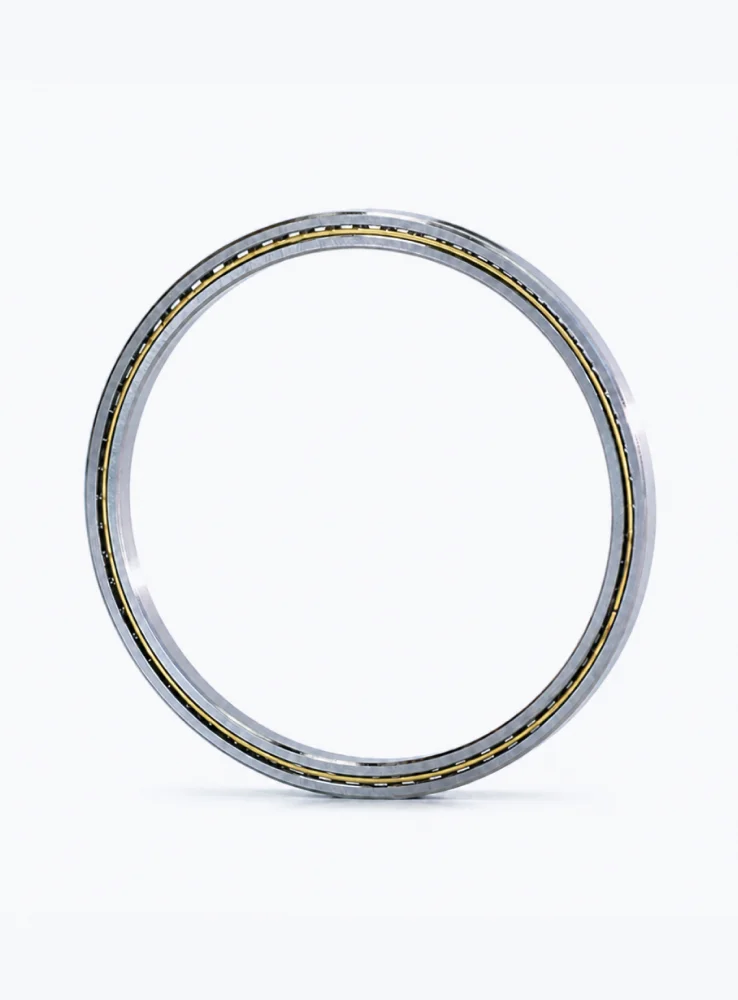
Across these five applications, the same engineering logic emerges. When the design envelope is small, loads can still be large; when precision matters, deflection is not an option; and when reliability is critical, contact stress must be minimized. Miniature crossed roller bearings deliver all three because they combine the compactness of a needle bearing with the rigidity of a tapered roller bearing.
For engineers evaluating motion components, BIBO Bearing offers more than standard products. We provide application engineering support, custom raceway grinding, and preload setting tailored to your specific torque profile. Whether your next product is a wafer robot, a medical imager, a satellite actuator, or a lidar system, a miniature crossed roller bearing can be the hidden enabler of your performance specification.
Need help selecting the right bearing? Contact BIBO Bearing with your load and accuracy requirements—we will help you calculate the correct preload and material solution.