
Home- Blogs- Bearing Knowledge-Why Thin-Section Bearings Are Critical for Miniature Satellite Mechanisms
Miniature satellites—often referred to as CubeSats or nanosatellites—have revolutionized space exploration by drastically reducing launch costs and enabling rapid deployment of constellations for Earth observation, communications, and scientific research. However, their compact form factor imposes severe constraints on every onboard component. Among the most challenging elements are the rotating mechanisms: reaction wheels, gimbals, solar panel drives, and deployable booms require bearings that are both extremely small and exceptionally precise. This is where thin-section bearings become indispensable. Unlike conventional ball bearings, thin-section bearings are designed with a radically reduced cross-section while maintaining high load capacity and rotational accuracy. They allow engineers to meet tight weight budgets, minimize friction in vacuum environments, and ensure long operational life without maintenance. In this article, we explore the critical role thin-section bearings play in miniature satellite mechanisms and why selecting the right supplier—such as BIBO Bearing—can make the difference between mission success and failure.
Every gram of mass in a miniature satellite comes at a premium. A 1U CubeSat (10×10×10 cm) typically weighs less than 1.33 kg, and mechanisms must fit within ever-shrinking envelopes. Standard deep-groove ball bearings, with their wide cross-sections, waste precious radial and axial space. Thin-section bearings, on the other hand, are engineered to have a cross-section that is a fraction of a standard bearing’s—often as thin as 2.5 mm or less—while still supporting the required loads. This enables designers to integrate rotating assemblies directly into compact housings without enlarging the overall satellite structure.
Satellite mechanisms must operate flawlessly for years in extreme conditions: vacuum, temperature swings from -50°C to +100°C, and exposure to radiation. A single bearing failure can disable a reaction wheel or jam a deployable antenna, rendering the satellite useless. Thin-section bearings are manufactured with tighter tolerances (e.g., ABEC 7/ISO P4 or better) to minimize runout and torque variation. Their reduced mass also means lower inertia, which is critical for attitude control systems that require rapid and precise angular adjustments. Furthermore, the use of specialized cage materials (e.g., phenolic or PEEK) and lubricants (such as perfluorinated oils or MoS₂ dry films) ensures reliable performance in vacuum without outgassing.
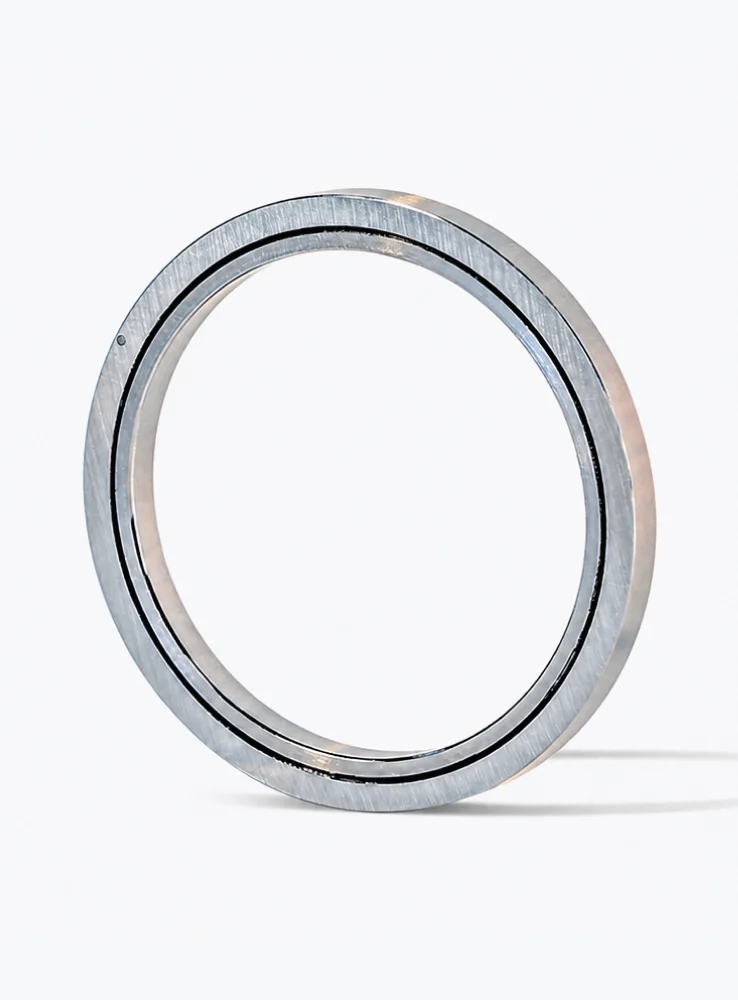
The defining feature of a thin-section bearing is that its cross-section (the radial dimension from bore to outer race) remains constant for a given series, regardless of the bore diameter. For example, a K-series thin-section bearing has the same cross-section of 9.525 mm for bore sizes from 1 inch all the way up to 40 inches. This design philosophy allows engineers to scale down the bearing’s outer diameter proportionally to the shaft size, saving mass and space. For miniature satellites, special low-section stainless steel (AISI 440C or 9Cr18) or ceramic hybrid variants (with Si₃N₄ balls) provide corrosion resistance and reduced wear. The thin cross-section also reduces the overall rotating mass, lowering power consumption in motor-driven mechanisms.
In space mechanisms, friction must be minimized to conserve battery power and avoid heat buildup. Thin-section bearings achieve low starting and running torque through precise raceway finishing, optimized ball complement, and advanced cage designs. For instance, a crown-type or a segmented retainer allows for free ball movement while ensuring spacing. The result is a bearing that can start from rest with minimal torque ripple—critical for fine-pointing instruments. BIBO Bearing, for example, offers thin-section bearings with specially matched internal clearance (C2 or C3) to accommodate thermal expansion without losing preload.
Space environments are unforgiving. Outgassing from lubricants can contaminate optics and sensors. Thin-section bearings intended for satellite mechanisms are therefore cleaned to NASA levels and assembled in class 10 cleanrooms. They may be treated with ion-plated solid lubricants or coated with titanium nitride to reduce friction and prevent cold welding in vacuum. Additionally, the compact geometry allows for better sealing—non-contact labyrinth seals or fluorocarbon seals can be integrated without adding significant weight. These features ensure that the bearing maintains its performance over the satellite’s lifetime, often exceeding 5–10 years in orbit.
To appreciate why thin-section bearings are the preferred choice for miniature satellite mechanisms, it helps to compare them directly with standard ball bearings. The table below summarizes the key differences:
Standard bearings are simply not optimized for the weight and space constraints of miniature satellites. Any attempt to use a downsized standard bearing usually results in excessive friction, insufficient load capacity, or premature failure. Thin-section technology solves these design dilemmas elegantly.
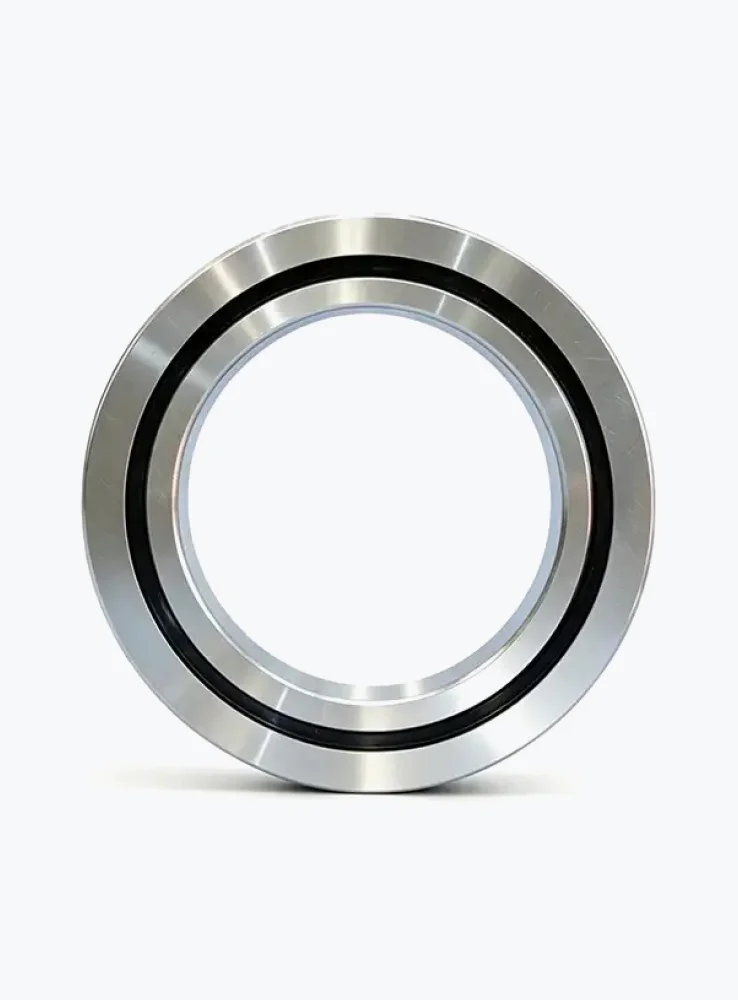
Choosing the correct thin-section bearing for a specific satellite mechanism requires careful analysis of several parameters. Load type and magnitude—reaction wheels experience predominantly axial preload, while solar panel drives see combined radial and moment loads. Speed range—most satellite mechanisms operate at low to moderate speeds (<3000 rpm), but rapid slewing maneuvers can generate high acceleration. Vacuum level and temperature cycling dictate lubricant selection: for ultra-high vacuum, dry lubricants are mandatory; for moderate vacuum with occasional atmosphere, a low-outgassing grease such as Braycote 601 might be acceptable. Required life—typically spacecraft demand 10⁷ to 10⁸ revolutions without servicing. BIBO Bearing provides detailed engineering support to match bearing series (e.g., KAA, KAB, KP, or KC) with these constraints, offering custom preloads, torque levels, and sealing options.
With decades of experience in precision bearing manufacturing, BIBO Bearing has established a reputation for supplying high-quality thin-section bearings to the aerospace industry. Their product portfolio ranges from miniature inch-series bearings (bore sizes as small as 1/4 inch) to metric thin-section bearings conforming to ISO and DIN standards. Every bearing undergoes rigorous inspection—including radial runout, torque testing, and cleanliness verification—before shipment. Moreover, BIBO Bearing offers custom modifications such as extra-thin sections, special stainless steel grades, and application-specific lubes. Their engineering team collaborates closely with satellite designers to optimize bearing geometry for unique mechanism requirements, ensuring that the final solution meets both performance and budget targets.
The rapid expansion of small satellite constellations—from Starlink to Planet Labs’ Doves—would be impossible without the reliability and compactness of thin-section bearings. Their unique ability to deliver high precision, low friction, and long life in a minimal footprint makes them a critical component for reaction wheels, gimbals, deployable structures, and optical pointing mechanisms. As satellite payloads become more demanding, the evolution of thin-section bearing materials and coatings will continue to push the boundaries of what’s possible. For engineers seeking a dependable partner, BIBO Bearing offers the technical depth and product range necessary to navigate the complexities of space-grade bearing selection. By integrating thin-section bearings from the conceptual design phase, satellite developers can unlock new levels of performance while staying within strict mass and volume budgets.