
Home- Blogs- Bearing Knowledge-How Thin-Section Bearings Reduce Weight in Aerospace Applications
The relentless pursuit of fuel efficiency, payload capacity, and maneuverability in aerospace engineering demands continuous weight reduction across every component. Among the most effective yet often overlooked solutions are thin-section bearings. These specialized bearings, with their exceptionally small cross-section relative to bore diameter, offer a compelling way to shed kilograms without compromising load capacity or reliability. For engineers and procurement professionals evaluating lightweight alternatives, understanding the mechanics, material science, and application-specific benefits of thin-section bearings is essential. This article examines how these components achieve significant mass savings in aircraft, satellites, and unmanned aerial systems, and why BIBO Bearing has become a trusted partner in precision aerospace applications.
Every gram added to an aerospace structure cascades into higher fuel consumption, reduced range, or compromised performance. Traditional rolling element bearings, with their full-section rings and heavy retainers, can contribute substantially to system mass — especially in applications requiring large diameters but relatively light loads. In rotary-wing aircraft, actuator systems, and satellite deployment mechanisms, the bearing can account for 5-15% of the total assembly weight. Designers increasingly turn to thin-section bearings as a direct replacement, achieving up to 60% weight reduction compared to conventional deep-groove ball bearings of equivalent inner diameter.
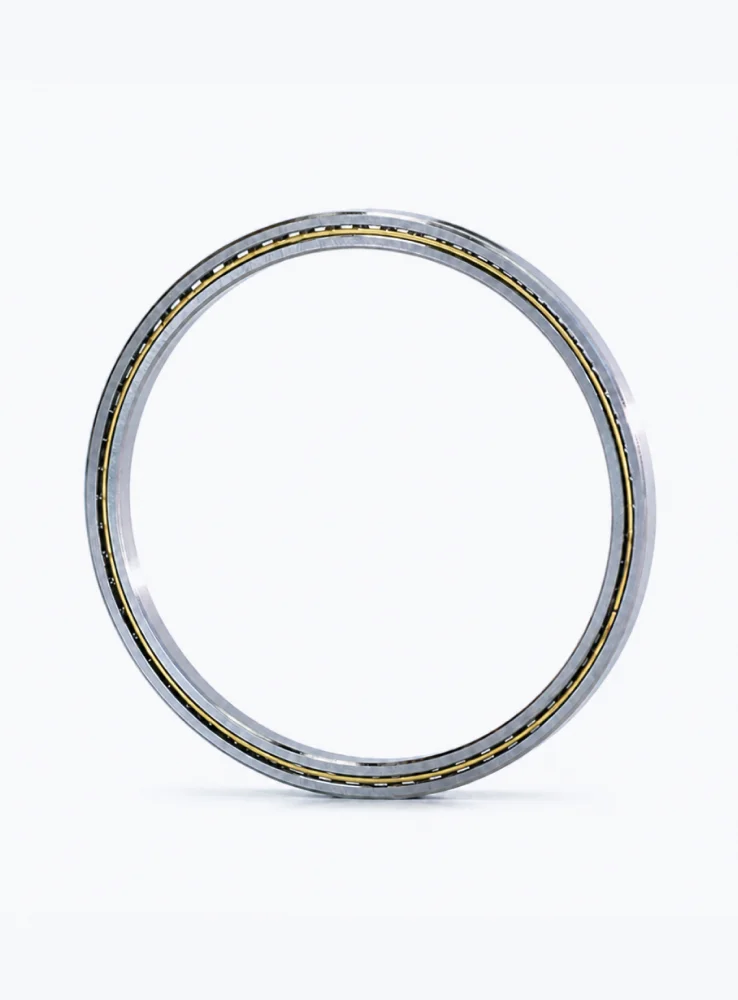
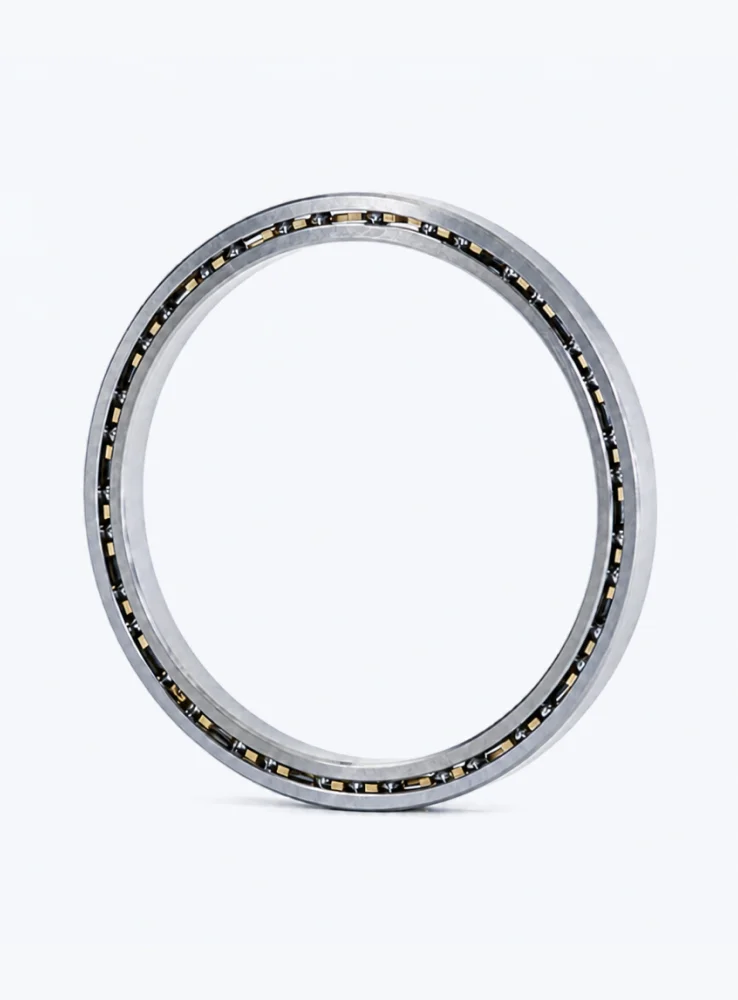
The weight-saving principle is straightforward: thin-section bearings maintain a constant, minimized cross-section regardless of bore size. Instead of scaling ring thickness proportionally with diameter, the radial and axial cross-sections remain fixed — typically between 3 mm and 12 mm — even for bearings exceeding 1 meter in bore diameter. This decoupling of diameter and cross-section yields dramatic mass savings while preserving key performance metrics.
In conventional bearing design, increasing bore diameter requires thicker rings to maintain structural rigidity. Thin-section topology breaks this paradigm. By using optimized raceway profiles and precision-ground rolling elements, the bearing can handle axial, radial, and moment loads within a significantly smaller envelope. The result is a bearing that weighs a fraction of its full-section counterpart while maintaining identical mounting dimensions and load ratings for many applications.
Weight reduction is amplified through advanced materials. Aerospace-grade thin-section bearings commonly use AISI 440C stainless steel or ceramic hybrid construction (silicon nitride balls with steel rings). These materials offer excellent corrosion resistance, high hardness, and reduced density. For ultra-lightweight requirements, rings can be manufactured from titanium alloys or polymer composites, further cutting mass by 30-40% compared to standard steel. BIBO Bearing specializes in custom material combinations to meet specific strength-to-weight targets.
Choosing thin-section bearings goes beyond simple weight savings; the architecture delivers multiple benefits that align with aerospace demands:
These advantages are particularly valuable in weight-critical assemblies such as helicopter swashplates, unmanned aerial vehicle (UAV) gimbals, and satellite reaction wheel supports.
Thin-section bearings have become standard in several specific aerospace subsystems:
Flight control actuators — for ailerons, elevators, and rudders — require bearings that can handle oscillatory motion and high moment loads without adding mass. Thin-section four-point contact bearings provide the necessary load capacity in a package that reduces actuator weight by 15-20%.
In space, every gram costs thousands of dollars to launch. Solar array hinges, antenna gimbals, and instrument positioning stages rely on thin-section bearings for their low friction and minimal mass. BIBO Bearing supplies vacuum-compatible thin-section bearings with custom MoS₂ solid lubricants for long-lifetime satellite applications.
Main rotor and tail rotor pitch control linkages benefit from thin-section ball bearings that reduce unsprung mass, improving vibration performance and blade control authority. Weight savings here also lower overall aircraft empty weight, increasing mission flexibility.
Thin-section bearings represent a mature, proven technology for weight reduction in aerospace systems. However, successful integration requires more than simply selecting a catalog part. Factors such as preload management, thermal expansion compensation, and fatigue life under oscillating loads demand deep engineering expertise. BIBO Bearing brings over a decade of experience in manufacturing custom thin-section bearings for demanding aerospace customers, offering ISO 9001:2015 certified production, AS9100D quality systems, and rigorous material traceability. By partnering with BIBO Bearing, design teams can confidently implement thin-section solutions that maximize weight savings while maintaining the reliability essential for flight.