Home- Blogs- Bearing Knowledge-How to Calculate Preload in Thin-Section Bearings for Zero Play
Thin-section bearings are the backbone of precision rotary applications, from robotics to medical imaging. Achieving zero play—where no measurable clearance exists between rolling elements and raceways—demands a careful preload calculation. Too little preload leaves axial or radial looseness; too much can overheat the bearing or reduce service life. This article walks you through the engineering logic and step-by-step methodology to compute the exact preload for your thin-section bearing assembly, using proven principles that also align with BIBO Bearing's manufacturing standards.
Preload is the intentional, permanent axial load applied to a bearing to eliminate internal clearance. In thin-section bearings—which have a cross-section as small as 1/16 of the bore diameter—the margin for error is extremely tight. Zero play ensures deterministic positioning, avoids vibration, and boosts stiffness. However, thin-section bearings are more susceptible to elastic deformation than standard bearings, so the preload must be calculated based on the bearing's internal geometry, material, and operating conditions.
BIBO Bearing engineers recommend using the bearing's internal contact angle and raceway curvature as starting parameters. For thin-section designs, the ball-raceway conformity factor typically ranges between 0.98 and 0.99.
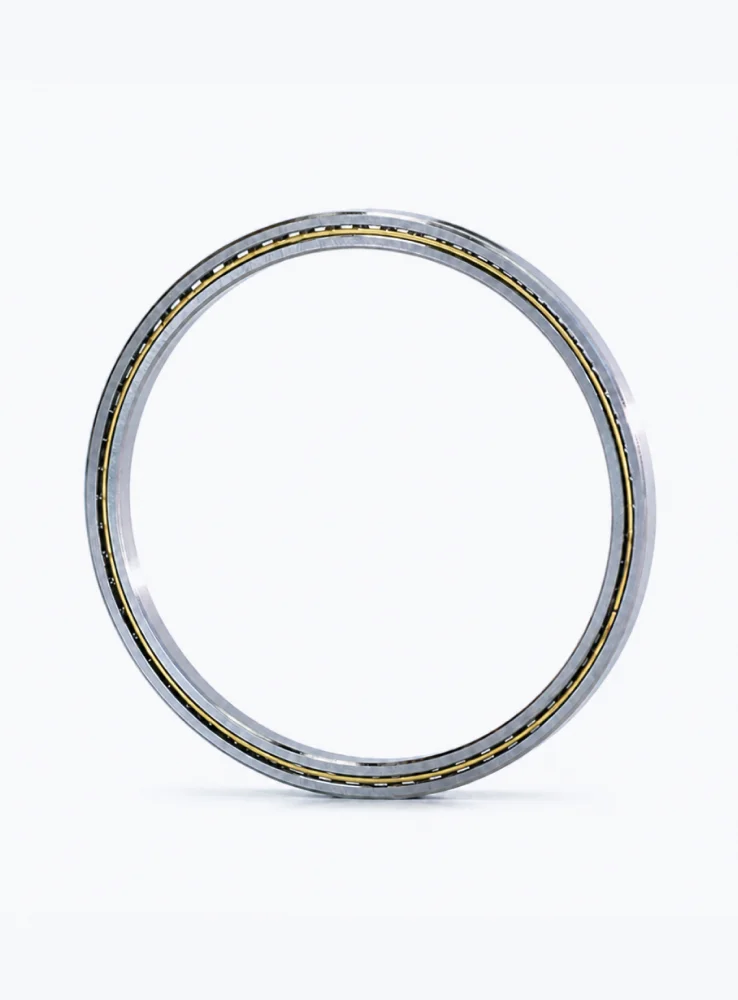
The calculation follows the principle that the elastic compression of rolling elements equals the initial clearance that must be overcome. The general formula for axial preload in an angular contact ball bearing (the most common thin-section type) is:
F_a = (K × δ^1.5) / (Z × sin α)
Where:
Refer to the bearing manufacturer's catalog for the standard radial clearance class (e.g., C2, CN, C3). For zero play, you need to close all measurable clearance. In thin-section bearings, radial clearance is often less than 10 µm. Convert radial clearance to an equivalent axial clearance using the contact angle: Axial clearance = Radial clearance / tan(α).
The preload deflection δ should equal the axial clearance plus a small extra compression (usually 1–3 µm) to ensure no residual gap. For fine-tuned applications, BIBO Bearing recommends using the empirical rule: δ = 1.1 × axial clearance as a starting point.
K depends on the ball diameter (dw) and the raceway groove radius. A simplified value for steel bearings: K ≈ 3500 × dw0.5 (N/mm1.5). For thin-section bearings with ball diameters under 6 mm, this approximation works well.
Insert Z, α, and calculated δ into the equation. Multiply the result by 1.15 to account for manufacturing tolerances—a safety factor recommended by BIBO Bearing's technical team.
The above theoretical value is a starting point. Several factors can shift the actual preload needed:
Temperature differences between the inner and outer rings can alter clearances. A steel bearing with a 30°C temperature rise may require 2–5% more preload to maintain zero play. Always account for the coefficient of thermal expansion (11.7 × 10⁻⁶/°C for steel).
If the housing is aluminum (thermal expansion ≈ 23 × 10−6/°C) while the bearing is steel, the interference fit will change with temperature. BIBO Bearing offers hybrid configurations with ceramic balls that reduce thermal sensitivity, but the preload calculation must include the fit-induced compression.
Two common methods exist for applying preload:
For zero-play applications, fixed-position preload is preferred. BIBO Bearing's thin-section series includes matched sets with calibrated spacers.
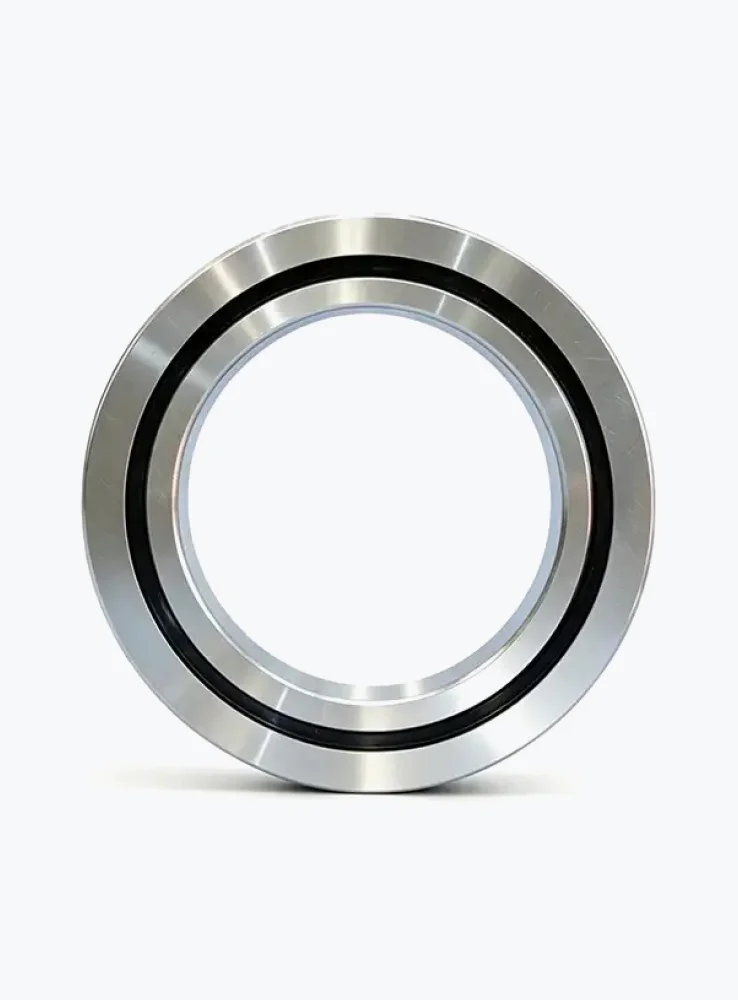
Achieving zero play doesn't stop at calculation. The bearing's manufacturing precision—raceway waviness, ball-spherical tolerance, and cleanliness—directly impacts the real-world outcome. BIBO Bearing specializes in thin-section bearings with ISO P4 and ABEC-7 tolerances, ensuring that the preload you calculate matches the performance you need.
Key advantages of BIBO Bearing products for zero-preload systems:
When you need technical support for preload calculation, BIBO Bearing's application engineers review your load, speed, and thermal profile to verify the ideal value.
After assembling the bearing with the calculated preload, validate zero play using low-torque rotation and displacement sensors. A properly preloaded thin-section bearing will exhibit less than 0.5 µm axial movement under a force reversal. If the play exceeds this threshold, increase preload by 5–10% increments and re-test. BIBO Bearing recommends documenting the actual preload torque value for future maintenance.
In summary, calculating preload for zero play in thin-section bearings requires precise measurements, a robust formula, and accounting for thermal and mounting effects. With the right approach—and the support of BIBO Bearing's precision components—your system will achieve the stiffness and accuracy demanded by modern automation.
7 Factors Affecting Thin-Section Bearing Torque and Efficiency
Choosing the Right Thin-Section Bearing for High-Speed Spindles
Impact of Thin-Section Bearing Materials on Performance and Cost
Thin-Section Bearings in 3D Printers: Achieving Smooth Motion
Thin-Section Bearing Lubrication Tips for Long Service Life
Why Thin-Section Bearings Are Critical for Miniature Satellite Mechanisms