Home- Blogs- Bearing Knowledge-Thin-Section Bearing Lubrication Tips for Long Service Life
Proper lubrication is the single most critical factor determining the operational life of thin-section bearings. Unlike standard bearings, their slim cross-section and unique geometry make them exceptionally sensitive to lubrication deficiencies, contamination, and thermal runaway. Even a minor oversight in grease type, quantity, or application frequency can lead to premature failure — often within weeks. This article provides actionable, engineering-driven guidance on how to select and apply lubricants for thin-section bearings, drawing on over a decade of field experience and testing. Whether you are designing a new system or maintaining existing equipment, these tips will help you achieve the long service life your application demands.
Thin-section bearings are defined by their extremely small cross-sectional height relative to their diameter. This design saves weight and space but introduces unique lubrication challenges that engineers must address.
In a standard bearing, the lubricant reservoir — typically grease — occupies a relatively large cavity between rolling elements and raceways. In thin-section bearings, that cavity is drastically reduced. This means:
Additionally, thin-section bearings often operate at higher speeds for their size, generating heat that can rapidly break down improper lubricants.
Field data from BIBO Bearing service reports indicates that over 40% of premature thin-section bearing failures are lubrication-related. The most frequent modes include:
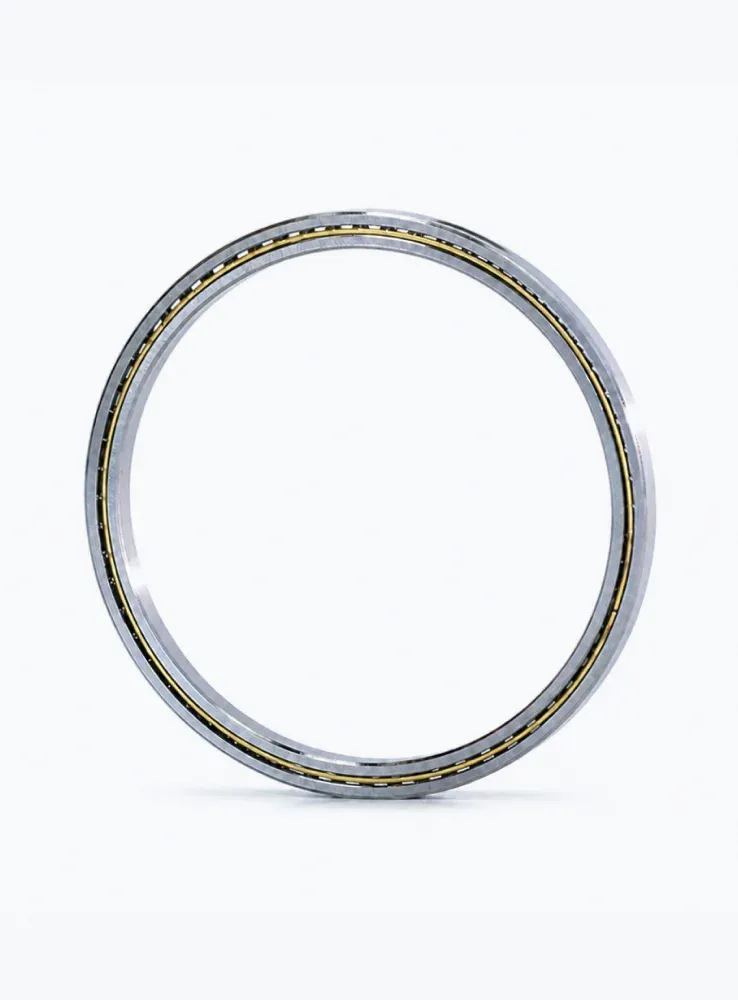
Choosing between grease and oil — and then selecting the correct specification — is the first critical decision. The table below summarizes the key trade-offs for thin-section applications.
| Factor | Grease | Oil |
|---|---|---|
| Ease of containment | Excellent — stays in place | Requires sealing or circulating system |
| Heat dissipation | Poor — grease insulates | Good — oil carries heat away |
| Speed capability | Limited (dN factor < 300,000 typical) | Higher speeds possible |
| Relubrication interval | Longer (weeks to months) | Shorter (days to weeks) |
| Contamination resistance | Better — grease blocks particles | Worse — particles circulate |
| Torque / friction | Higher initial breakaway torque | Lower running torque |
For most thin-section bearing applications — especially those in robotics, aerospace actuators, and medical devices — grease is the preferred choice due to simplicity and long maintenance intervals. However, if the bearing operates above 80°C continuously or at very high speeds, a synthetic oil with a circulating system may be necessary.
When selecting a grease for a thin-section bearing, focus on three properties:
BIBO Bearing recommends cross-referencing the bearing's dN value (bore mm × RPM) with the lubricant manufacturer's dN rating. Many standard greases are not rated for the high dN values that thin-section bearings can achieve.
Even the best lubricant will fail if applied incorrectly. Thin-section bearings demand precision in both quantity and method.
A common rule of thumb for standard bearings is to fill the free space about 30–50% with grease. For thin-section bearings, the target fill is 20–35% of the free volume — never above 40%. Overfilling is the primary cause of thermal runaway in these bearings.
The relubrication interval depends on the operating temperature and speed. As a starting point, use the formula:
Relubrication interval (hours) = K × (106 / (n × dm))
where K is a factor (typically 1.0 for clean, 0.5 for dusty environments), n is RPM, and dm is the bearing mean diameter in mm. For thin-section bearings, we recommend reducing the calculated interval by 20% because of the smaller grease reservoir.
For initial lubrication (factory or rebuild):
For in-service relubrication:
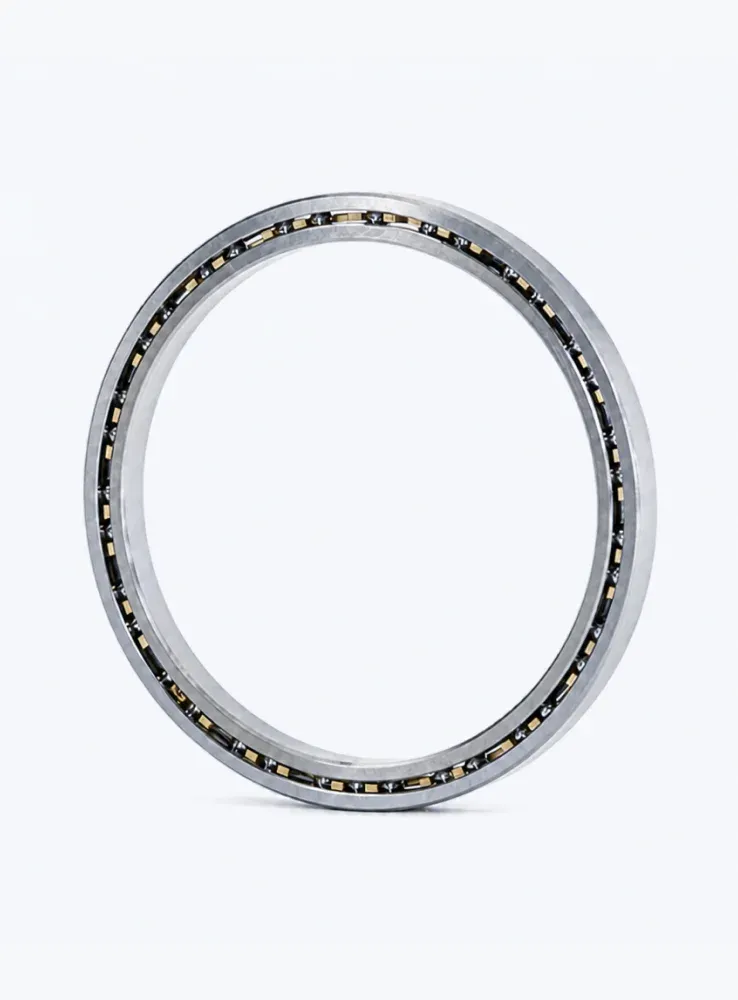
Drawing on thousands of thin-section bearing applications across industries, BIBO Bearing engineers have distilled four practical tips that directly impact lubrication success:
BIBO Bearing offers a full line of thin-section bearings pre-lubricated with optimized greases for common application profiles. For custom applications, our engineering team provides lubricant selection and relubrication schedule recommendations based on your specific duty cycle.
Thin-section bearings are precision components that deliver remarkable performance when treated correctly — and lubrication is the foundation of that performance. By selecting the right lubricant type and grade, applying it in the correct quantity, and following a disciplined relubrication schedule, engineers can extend service life by 2× or more compared to suboptimal practices. Remember: in thin-section bearings, less is often more when it comes to grease volume, but never compromise on quality. For application-specific guidance, consult the experts at BIBO Bearing who understand the nuances of these demanding components.
7 Factors Affecting Thin-Section Bearing Torque and Efficiency
Choosing the Right Thin-Section Bearing for High-Speed Spindles
Impact of Thin-Section Bearing Materials on Performance and Cost
Thin-Section Bearings in 3D Printers: Achieving Smooth Motion
How to Calculate Preload in Thin-Section Bearings for Zero Play
Why Thin-Section Bearings Are Critical for Miniature Satellite Mechanisms