Home- Slewing Bearing-Crossed Roller Slewing Bearing (External Gears)
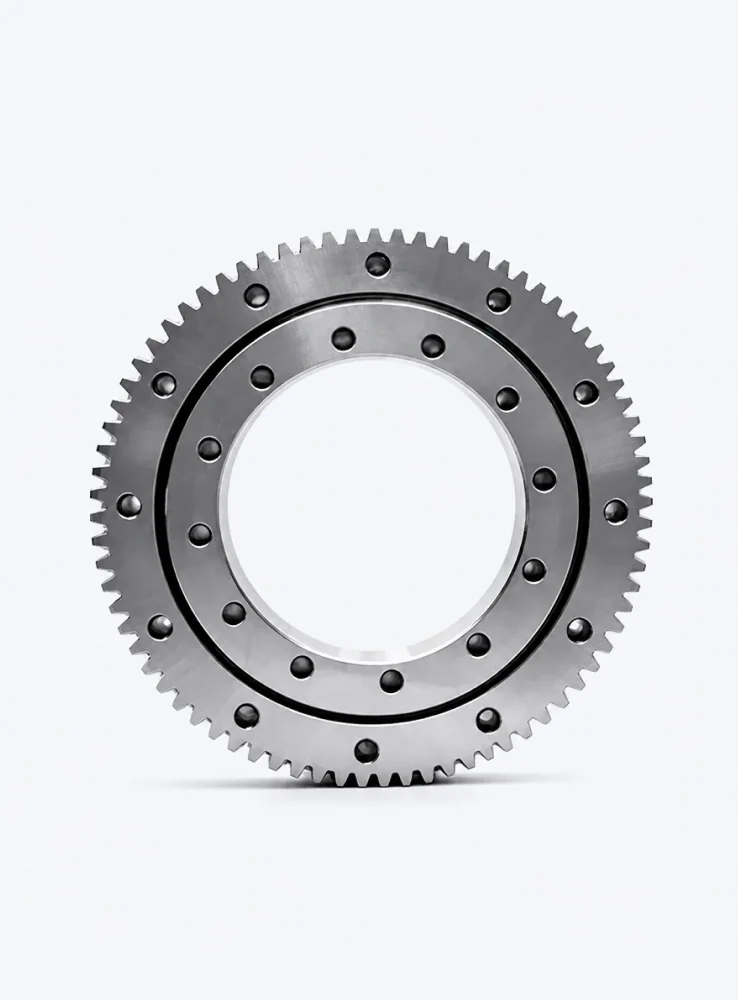
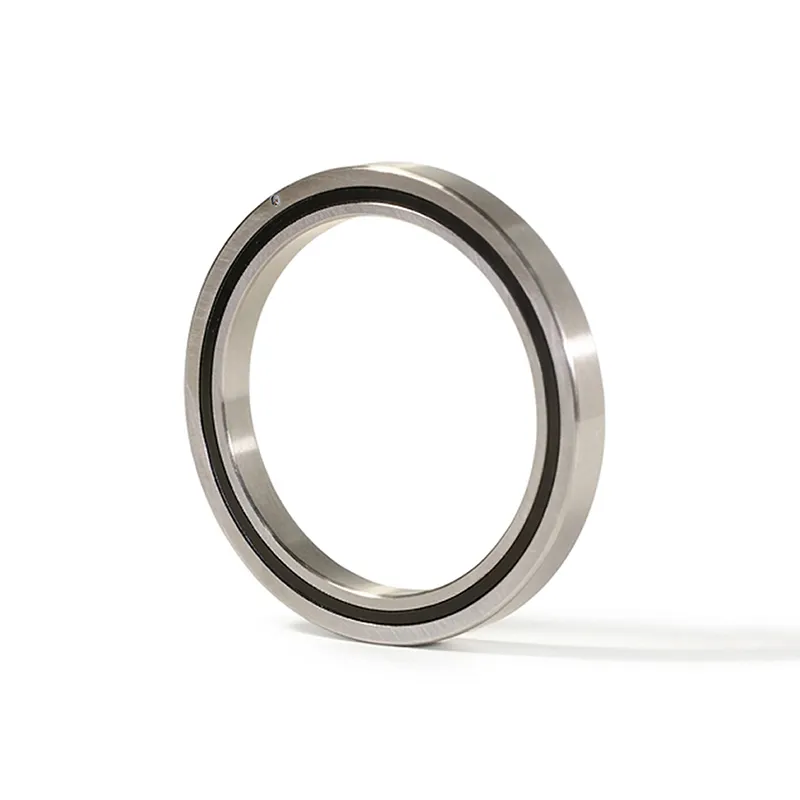
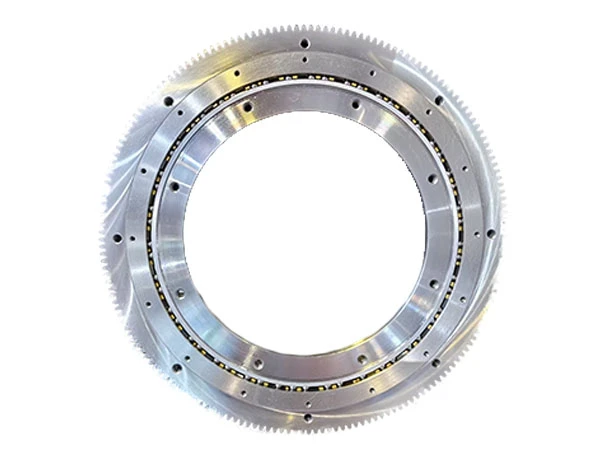
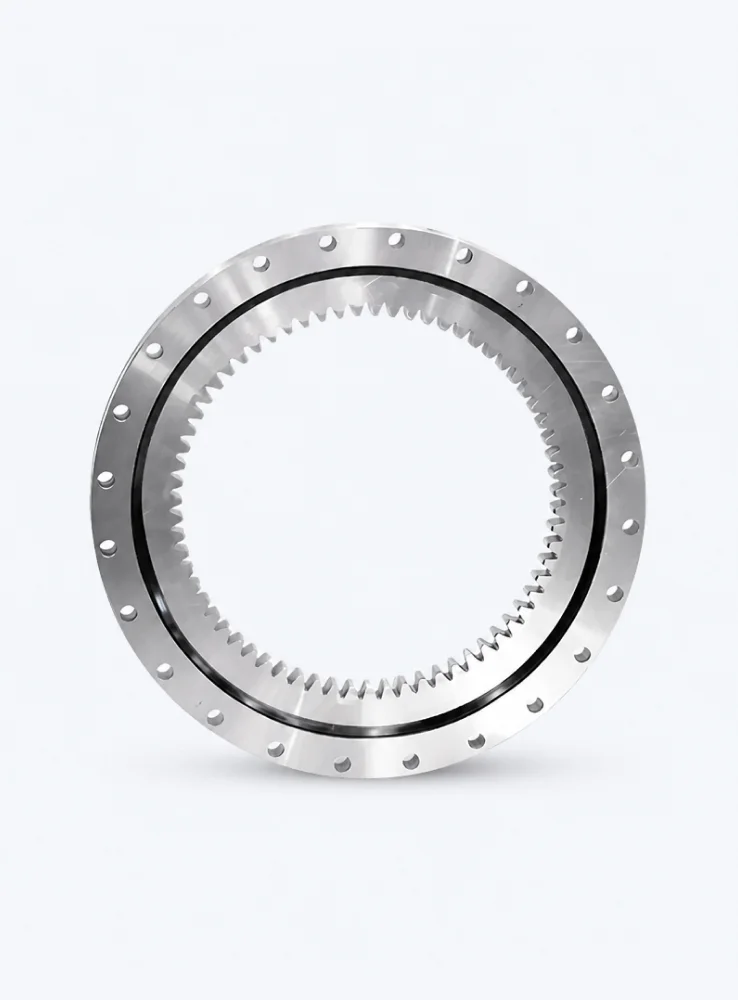
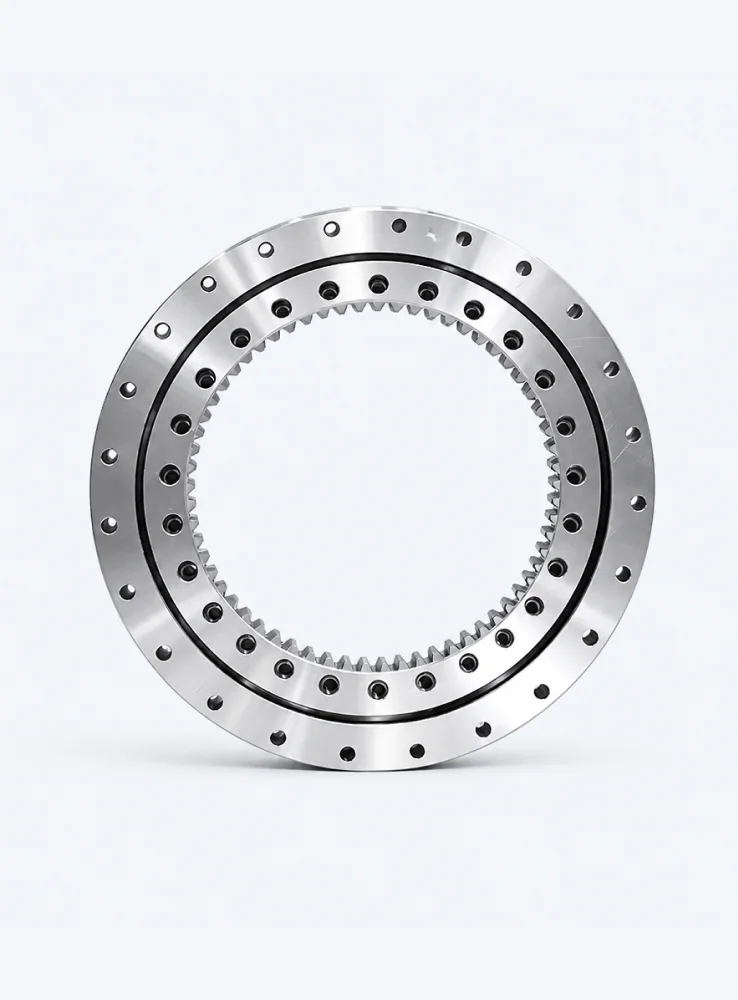
Crossed roller slewing bearings (External Gears) combine a 90° crossed cylindrical roller arrangement with an integrated external gear ring, providing high rigidity, excellent moment-load capacity, and stable rotational accuracy in a compact structure. The crossed rollers create line contact with the raceways, enabling the bearing to simultaneously accommodate radial loads, axial loads, and overturning moments, while the external gear allows direct engagement with a pinion for efficient rotary drive. Designed for precision automation, rotary platforms, machine tools, robotics, port equipment, and other demanding applications, this bearing is a practical solution where load capacity, positioning accuracy, and reliable power transmission are critical.
Externally geared crossed roller slewing bearings are key components designed for high-load, precision rotary motion applications, widely used in engineering machinery, automation equipment, port machinery, and high-precision industrial equipment. This product combines an external gear ring with a cross-arranged roller structure to achieve high rigidity, high precision, and multi-directional composite load-bearing capacity, maintaining stable rotational performance even under complex conditions.
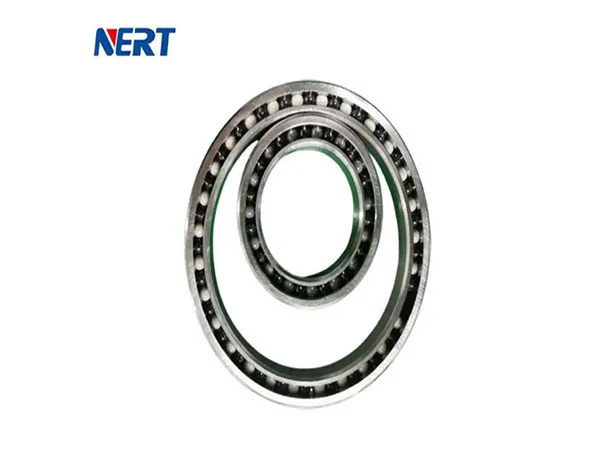
Structurally, externally geared crossed roller slewing bearings typically consist of an external gear ring, an inner ring, rolling elements, and a cage. The external gear ring directly meshes with the pinion gear in the drive system, providing a more direct and efficient power transmission path during rotary drive. The cross-arranged rollers, with the rollers staggered at 90 degrees, can simultaneously withstand axial forces, radial forces, and overturning moments, significantly improving overall load-bearing stability and deformation resistance.
In terms of working principle, when the driving force is transmitted through the external gear ring, the rollers undergo rolling contact motion between the inner and outer raceways. Because the rollers are arranged in a cross pattern, the force can be evenly distributed across multiple dimensions, effectively reducing localized stress concentration. This design not only extends service life but also maintains good operational stability under high-frequency rotation or heavy-load impact conditions.
Material selection and heat treatment processes have a decisive impact on product performance. The industry typically uses high-strength alloy structural steel, such as 42CrMo or 50Mn, as the main raw material, and improves the raceway hardness and wear resistance through overall tempering, surface hardening, and precision grinding. Standardized heat treatment processes effectively improve the material's fatigue resistance, ensuring the slewing bearing maintains dimensional stability and structural reliability under long-term continuous operation.
In practical applications, external toothed cross roller slewing bearings are commonly found in excavator slewing platforms, crane slewing mechanisms, tunnel boring machine main drive systems, wind power generation yaw systems, and automated slewing platforms. These applications generally feature complex loads, limited space, and high requirements for continuous operation, thus demanding higher standards for the precision and reliability of the slewing bearing.
During the selection process, users typically need to comprehensively consider multiple key parameters such as axial load, radial load, overturning moment, installation space, and gear module. Appropriate selection not only improves overall machine operating efficiency but also reduces subsequent maintenance costs. For different operating conditions, manufacturers can usually provide customized design solutions to match the structural layout and power system of different equipment.
From a quality control perspective, slewing bearings that meet international standards typically undergo multiple testing processes, including material flaw detection, dimensional accuracy inspection, tooth profile accuracy verification, and rotational resistance testing. A rigorous quality control system ensures consistent performance under complex operating conditions, which is a crucial foundation for ensuring long-term stable operation of the equipment.
Regarding maintenance and use, proper lubrication management is essential for extending service life. Users typically need to select appropriate grease based on the working environment and replenish or replace it periodically according to the operating cycle. Simultaneously, coaxiality control and preload adjustment during installation directly affect the operating condition of the slewing bearing.
Overall, external gear crossed roller slewing bearings, with their high load-bearing capacity, high rigidity structure, and excellent transmission efficiency, have become indispensable core components in modern heavy equipment and precision mechanical systems. With the development of industrial automation and high-end equipment manufacturing, the demand for these products in more high-precision, high-load applications continues to grow, providing crucial support for equipment performance optimization.
1. What types of equipment are externally geared crossed roller slewing bearings mainly used in?
Externally geared crossed roller slewing bearings are typically used in equipment requiring high load capacity and high-precision rotation, such as excavators, cranes, tunnel boring machines, wind power yaw systems, port lifting equipment, and heavy-duty automated slewing platforms. These types of equipment often experience complex load conditions, thus requiring high structural strength and operational stability from the slewing bearing.
2. What are the advantages of external gear structures compared to internal gear or toothless structures?
Externally geared structures can directly mesh with the drive pinion, making the transmission path more direct and the transmission efficiency higher. At the same time, the external gear design facilitates the arrangement of the drive system, making it suitable for equipment structures with relatively open space, and contributing to more stable power output.
3. What are the core advantages of crossed roller structures?
Crossed roller structures, by arranging the rollers at 90° intervals, allow a single bearing to simultaneously withstand axial force, radial force, and overturning moment. This design significantly improves overall rigidity and load-bearing capacity, while effectively reducing vibration and off-center loading during operation, thereby improving equipment operational stability.
4. Is the product prone to deformation or failure under high load conditions?
Provided that the model is properly selected and meets the design parameters for the operating conditions, the external toothed crossed roller slewing bearing has strong resistance to deformation. Its raceways undergo precision heat treatment and grinding, maintaining structural stability under long-term high-load operation. However, overloading or improper installation can still lead to abnormal wear; therefore, proper selection and installation are crucial.
5. What are the key points to note during installation?
During installation, the flatness and coaxiality of the mounting surface should be carefully controlled, and external forces should be avoided to forcefully impact the rolling elements or tooth surfaces. After installation, pre-tightening adjustments should be made according to regulations, and a no-load test run should be conducted to confirm that the rotation is smooth and free from jamming.
6. Does the product support non-standard customization?
External tooth cross roller slewing bearings typically support non-standard customization, including dimensions, tooth profile parameters, material selection, and special working condition designs, to meet the structural layout and performance requirements of different equipment.
7. What routine maintenance is required?
Routine maintenance mainly includes regularly replenishing or replacing grease, checking tooth surface wear, monitoring changes in operating noise and resistance, and checking the tightness of connecting bolts. Proper maintenance can effectively reduce the failure rate and extend equipment life.
8. Is the product suitable for high-precision equipment?
This type of slewing bearing has high structural rigidity and rotational accuracy, making it suitable for equipment with high positioning accuracy requirements, such as automated slewing platforms, precision engineering machinery, and some industrial robot slewing mechanisms.
| NEXA Series Crossed Roller Slewing Bearing Unit:mm | ||||||||||
| Part number | d | D | H | Size & Number of Mounting holes | Basic Load Rating(Radial) | Weight | Equivalent to | |||
| φLa | φLi | na/ni | Cr (kN) | Cor (kN) | (Kg) | |||||
| NEXA12.235 | 171 | 318.8 | 40 | 275 | 195 | 12 | 92 | 138 | 13.21 | XA120235 |
| NEXA14.544 | 474 | 640.3 | 56 | 585 | 498 | 28/32 | 164 | 345 | 44.1 | XSA140544 |
| NEXA14.644 | 574 | 742.3 | 56 | 685 | 598 | 32/36 | 181 | 415 | 52 | XSA140644 |
| NEXA14.744 | 674 | 838.1 | 56 | 785 | 698 | 36/40 | 195 | 475 | 60 | XSA140744 |
| NEXA14.844 | 774 | 950.1 | 56 | 885 | 798 | 36/40 | 210 | 540 | 71 | XSA140844 |
| NEXA14.944 | 874 | 1046.1 | 56 | 985 | 898 | 40/44 | 223 | 610 | 77 | XSA140944 |
| NESA Series Crossed Roller Slewing Bearing Unit:mm | ||||||||||
| Part number | d | D | H | Size & Number of Mounting holes | Basic Load Rating(Radial) | Weight | Equivalent to | |||
| φLa | φLi | na/ni | Cr (kN) | Cor (kN) | (Kg) | |||||
| NESA20.544 | 472 | 640.3 | 56 | 585 | 498 | 28/32 | 138 | 144 | 42 | VA200544 |
| NESA20.644 | 572 | 742.3 | 56 | 685 | 598 | 32/36 | 147 | 475 | 52.1 | VA200644 |
| NESA20.744 | 672 | 838.1 | 56 | 785 | 698 | 36/40 | 155 | 550 | 61.83 | VA200744 |
| NESA20.844 | 772 | 950.1 | 56 | 885 | 798 | 36/40 | 163 | 620 | 71 | VA200844 |
| NESA20.944 | 872 | 1046.1 | 56 | 985 | 898 | 40/44 | 170 | 700 | 77 | VA200944 |
| NSLA Series Crossed Roller Slewing Bearing Unit:mm | ||||||||||
| Part number | d | D | H | Size & Number of Mounting holes | Basic Load Rating(Radial) | Weight | Equivalent to | |||
| φLa | φLi | na/ni | Cr (kN) | Cor (kN) | (Kg) | |||||
| NSLA20.414 | 304 | 503.3 | 56 | 455 | 332 | 12 | 124 | 110 | 28.4 | VLA200414 |
| NSLA20.544 | 434 | 640.3 | 56 | 585 | 462 | 14 | 138 | 144 | 41.7 | VLA200544 |
| NSLA20.644 | 534 | 742.3 | 56 | 685 | 562 | 16 | 147 | 171 | 48.4 | VLA200644 |
| NSLA20.744 | 634 | 838.1 | 56 | 785 | 662 | 18 | 155 | 197 | 54.5 | VLA200744 |
| NSLA20.844 | 734 | 950.1 | 56 | 885 | 762 | 18 | 163 | 224 | 66 | VLA200844 |
| NSLA20.944 | 834 | 1046.1 | 56 | 985 | 862 | 20 | 170 | 250 | 70.32 | VLA200944 |
Custom configurations available upon request—contact Luoyang BOBI Bearings. Approved drawings govern all production intent.