Home- Blogs- Bearing Knowledge-OEM vs Aftermarket Crossed Roller Bearings: What to Pick
When a crossed roller bearing fails in a precision rotary table, robotic joint, or medical imaging system, the replacement decision carries real engineering weight. Order an OEM part and you secure guaranteed specifications, but you typically pay a premium price and wait through extended lead times. Choose an aftermarket crossed roller bearing and you may cut costs significantly, yet quality varies widely from one supplier to the next. This article breaks down the real differences between OEM and aftermarket crossed roller bearings, covering materials, tolerances, traceability, pricing, and lead times, so you can select the right bearing for your specific application and risk tolerance.
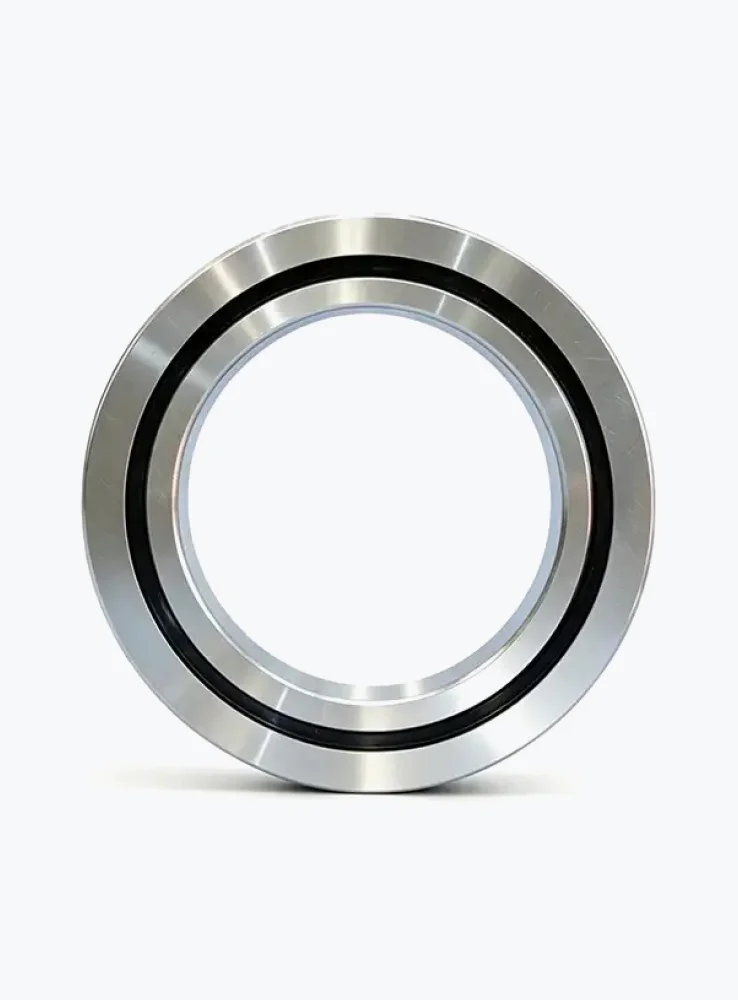
Crossed roller bearings are a type of rolling bearing in which cylindrical rollers are arranged perpendicular to one another at 90-degree angles within a single raceway. This unique configuration allows the bearing to carry high radial, axial, and moment loads simultaneously while occupying far less axial space than traditional ball bearings or double-row roller bearings.
Because of their compact design and high rigidity, crossed roller bearings are the backbone of applications such as:
In these environments, a bearing is not a commodity part. A few microns of tolerance deviation can translate into positioning errors, vibration, premature wear, or catastrophic loss of motion control. That is precisely why the OEM-versus-aftermarket decision matters more for crossed roller bearings than for ordinary ball bearings.
Before diving into detailed evaluation criteria, it is useful to understand the fundamental distinctions between OEM and aftermarket crossed roller bearings.
OEM bearings are manufactured either by the original machinery builder or by their designated bearing supplier to exact blueprint specifications. Every dimension, material grade, heat treatment, and surface finish is defined by the machine developer.
Aftermarket bearings are produced by independent manufacturers who reverse-engineer or design around the original part dimensions. The defining characteristic is that they are made to be interchangeable with OEM parts, but the manufacturing standards are set by the bearing maker, not the machine builder.
The central question is not whether aftermarket bearings are inherently worse. The question is whether a specific aftermarket supplier can match the engineering requirements of your application.
Crossed roller bearings are classified by precision grades under standards such as ISO 492 and JIS B 1514. Common grades include P0 (standard), P6, P5, and P4 (precision). OEM bearings typically ship at P5 or P4 for motion-control applications, with measured runout values documented for every axis.
When evaluating aftermarket suppliers, always request the actual inspection report. A reputable manufacturer like BIBO Bearing publishes measured radial runout, axial runout, and torque variation data for each bearing grade. If a supplier cannot produce documented precision data, treat that as a warning sign.
The steel grade and heat treatment process determine how long your bearing will maintain its preload and precision. Most crossed roller bearings are manufactured from GCr15 (equivalent to AISI 52100) bearing steel or, for higher corrosion resistance, 440C stainless steel. The hardening process must achieve 58-63 HRC on the raceway without creating surface decarburization or residual austenite instability.
Here is where aftermarket products diverge the most. A low-cost aftermarket bearing may skip the sub-zero treatment step that converts retained austenite, leading to dimensional drift over time. It may also use a lower-cost steel substitution that changes load capacity. Always ask for material certificates and heat treatment reports. In this regard, a credible aftermarket manufacturer is indistinct from an OEM's specialized bearing supplier in every meaningful way.
It is tempting to compare only the invoice price. The complete cost picture includes:
In applications where unplanned downtime is expensive, the cheapest bearing is rarely the most economical choice.
OEM crossed roller bearings are often built to order. Depending on the manufacturer and part family, lead times range from 8 to 16 weeks. If your machine is already down, that is a long time to wait. Aftermarket suppliers typically maintain inventory of the most common sizes, and many can ship critical bearings within 24-72 hours.
For maintenance, repair, and operations (MRO) applications, the aftermarket's fast availability is a decisive advantage.
OEM components come with the protection of the machine builder's warranty, but the practical process of filing a warranty claim can move slowly. Aftermarket manufacturers often provide more direct technical support because you are talking directly to the bearing experts rather than to a third-party customer service desk.
BIBO Bearing, for instance, supports every order with application engineering assistance, from load calculation to custom preload selection. For engineers who value responsive support, this direct access is a real benefit. Just verify in advance what the supplier will do if the bearing fails in the first 12 months of service.
After reviewing the factors above, there are specific scenarios where an aftermarket crossed roller bearing is clearly the right decision:
On the other hand, an aftermarket manufacturer that can provide these documents, holds certification to ISO 9001, and has engineering staff available to discuss your load requirements is actually acting like a professional bearing maker. In that case, relying on the aftermarket carries very low risk.
They can be, provided the aftermarket manufacturer follows the same material specifications, heat treatment, and precision grinding processes used by the OEM's original supplier. Documented inspection reports are the only reliable way to confirm this.
Aftermarket bearings generally cost 20-40% less than OEM parts of the same size and precision class. The exact difference depends on the bearing dimensions, accuracy grade, order volume, and the supplier's production efficiency.
Yes, when the aftermarket bearing matches the OEM dimensional envelope, mounting hole pattern, and tolerance class. Most reputable aftermarket manufacturers measure original bearings to ensure interchangeability. However, always confirm the raceway curvature and preload specification, as these affect rigidity under load.
Standard aftermarket sizes in stock can ship in 24-72 hours. Custom dimensions or special precision grades typically require 2-4 weeks, which is still faster than many OEM repair schedules.
Choosing between OEM and aftermarket crossed roller bearings is a matter of engineering judgment, not a universal rule. If your machine is under warranty, if your application is mission-critical with zero tolerance for failure, or if your industry has mandated OEM parts under regulatory requirements, stay with the OEM.
If you are managing a repair, modernizing legacy equipment, or working directly with a reputable aftermarket manufacturer that offers full documentation, engineering support, and a solid warranty, the aftermarket path offers significant savings without sacrificing performance. Conduct an audit of your critical requirements, request the relevant certificates from your shortlisted suppliers, and base the decision on documented data, not on brand assumptions.
BIBO Bearing has supplied precision crossed roller bearings to robotics, medical equipment, and automation customers worldwide, with the confidence of full test documentation and engineering consultation. If you are evaluating an aftermarket source and would like an engineering validation of the bearing specification, the team is ready to support you.